MENA Impact Women survey reveals pressures on income, suitable work and digital futures
What happens when highly educated women face rising living costs, limited suitable work and a labour market transformed by AI? New findings from MENA Impact Women, the newly established independent and women-led platform advancing research, strategic empowerment and regional initiatives, reveal three urgent pressures reshaping women’s professional futures across the Middle East and North Africa.
Across the MENA region, women are navigating a period of rapid economic and technological change. Rising living costs are weakening financial security, suitable professional opportunities remain difficult to access, and the expansion of artificial intelligence is changing the skills and forms of work that will shape future participation.
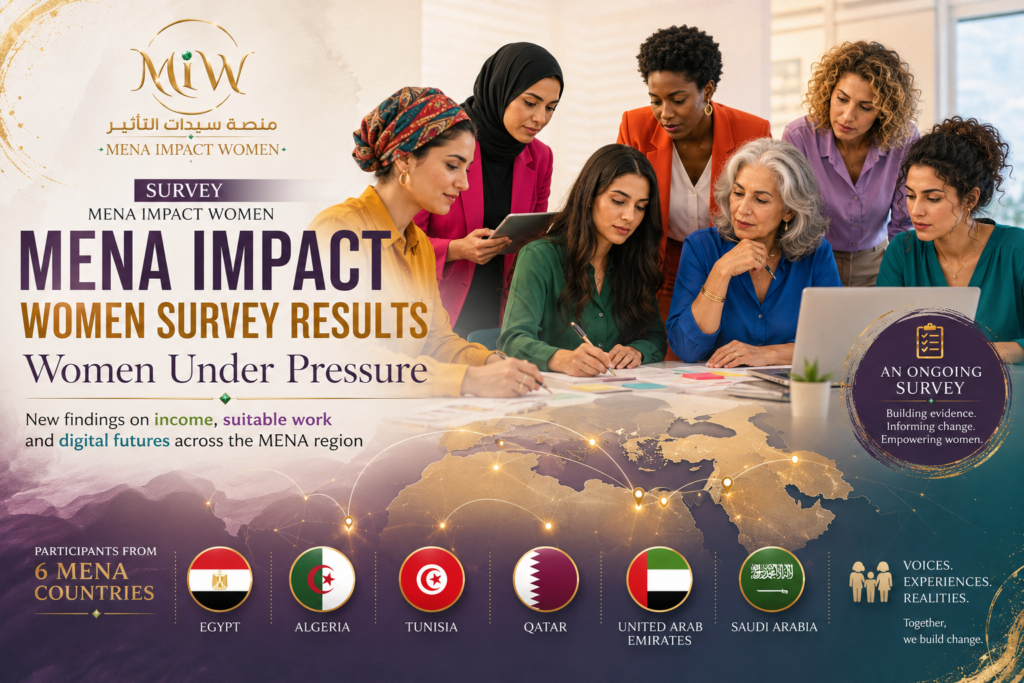
Fresh evidence from the ongoing Arabic-language MENA Impact Women Under Pressure Survey, launched in April 2026, is beginning to show how these pressures are being experienced directly by women in Egypt, Algeria, Tunisia, Qatar, the United Arab Emirates and Saudi Arabia.
The emerging results point to three urgent and interconnected challenges.
First, The Cost-of-Living Crisis Is Eroding Women’s Economic Security
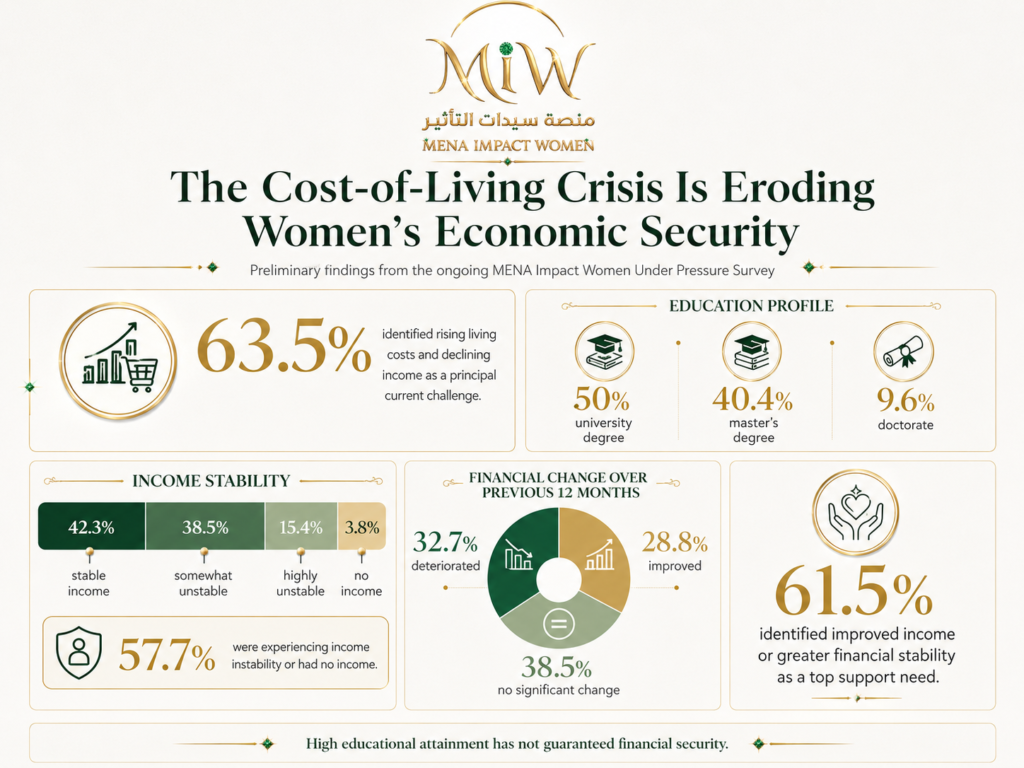
Economic pressure is the most widely reported current challenge. 63.5% of respondents identified rising living costs and declining income among the principal difficulties affecting their lives.
This pressure is occurring despite a highly educated respondent profile: 50% hold a university degree, 40.4% hold a master’s degree and 9.6% hold a doctorate. Educational achievement, however, has not guaranteed financial security.
Only 42.3% described their income as stable. A further 38.5% reported somewhat unstable income, 15.4% described it as highly unstable and 3.8% had no income. Taken together, 57.7% were therefore experiencing some form of income instability or had no income at all.
Financial conditions are also moving in different directions. Over the previous 12 months, 32.7% reported that their situation had deteriorated, compared with 28.8% who had experienced improvement. Another 38.5% reported no significant change.
These pressures affect more than current consumption. Without reliable income, women may find it harder to invest in further learning, change professional direction, relocate for work or develop an independent activity. The priorities reported in the survey reflect this reality: 61.5% identified improved income or greater financial stability as one of the most important forms of support they currently need.
Second, Suitable Work Is Failing to Match Women’s Skills and Realities
The second emergency is the distance between women’s capabilities and the professional opportunities available to them.
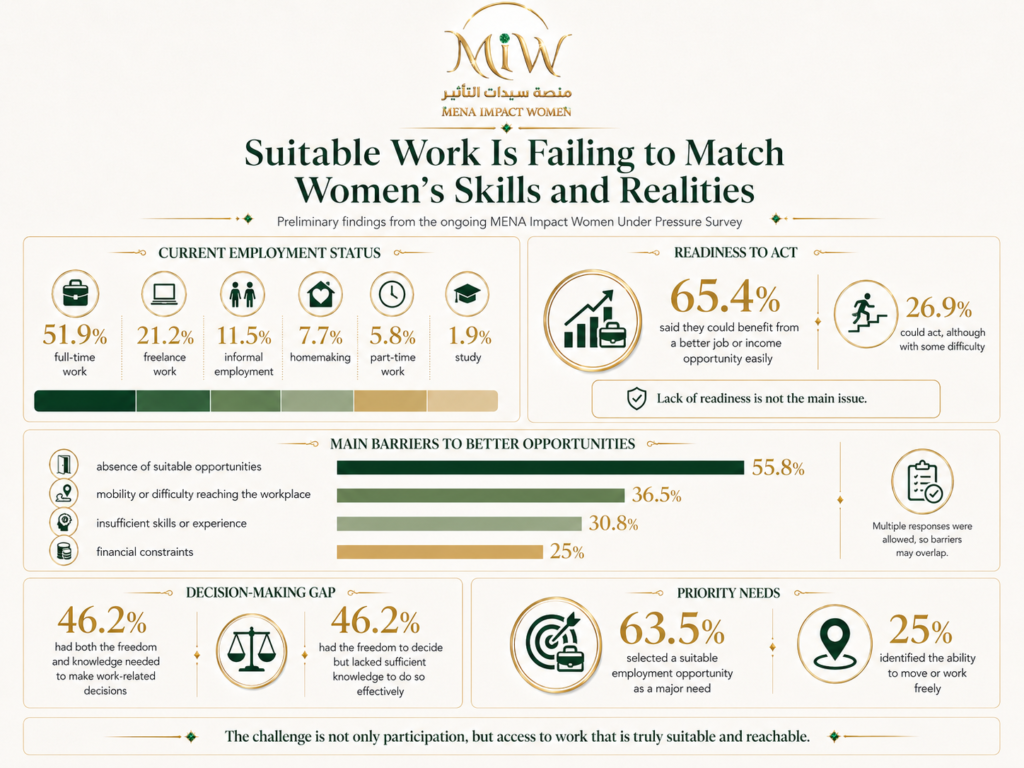
Only 51.9% of respondents were working full-time. Others were engaged in freelance work (21.2%), informal employment (11.5%), homemaking (7.7%), part-time work (5.8%) or study (1.9%).
The survey indicates that this situation cannot simply be explained by a lack of readiness to work. When asked whether they could benefit from a better job or income opportunity, 65.4% said they could do so easily and another 26.9% said they could act, although with some difficulty.
The largest obstacle was instead the absence of suitable opportunities, reported by 55.8%. Mobility or difficulty reaching the workplace affected 36.5%, while 30.8% identified insufficient skills or experience and 25% reported financial constraints. Because respondents could select more than one answer, these barriers frequently overlap.
The distinction between an available job and a suitable opportunity is essential. Employment may remain inaccessible when its location, cost, conditions or required skills do not correspond to women’s actual circumstances.
This gap is also visible in professional decision-making. While 46.2% reported having both the freedom and knowledge needed to make work-related decisions, another 46.2% said they had the freedom to decide but lacked sufficient knowledge to do so effectively.
Respondents’ priorities reinforce the same message. 63.5% selected a suitable employment opportunity as a major need—the highest proportion recorded—while 25% identified the ability to move or work freely.
The challenge is therefore not simply to encourage women to participate. It is to connect their qualifications and willingness to act with employment, information and support that are genuinely accessible.
The AI Transition Risks Creating a New Gender Divide
Artificial intelligence is accelerating changes already taking place across labour markets. It is altering professional tasks, recruitment, communication, entrepreneurship and the skills through which people create economic value.
The survey did not ask respondents to evaluate AI directly, but its results identify conditions that could determine whether women benefit from this transition or are pushed further behind.
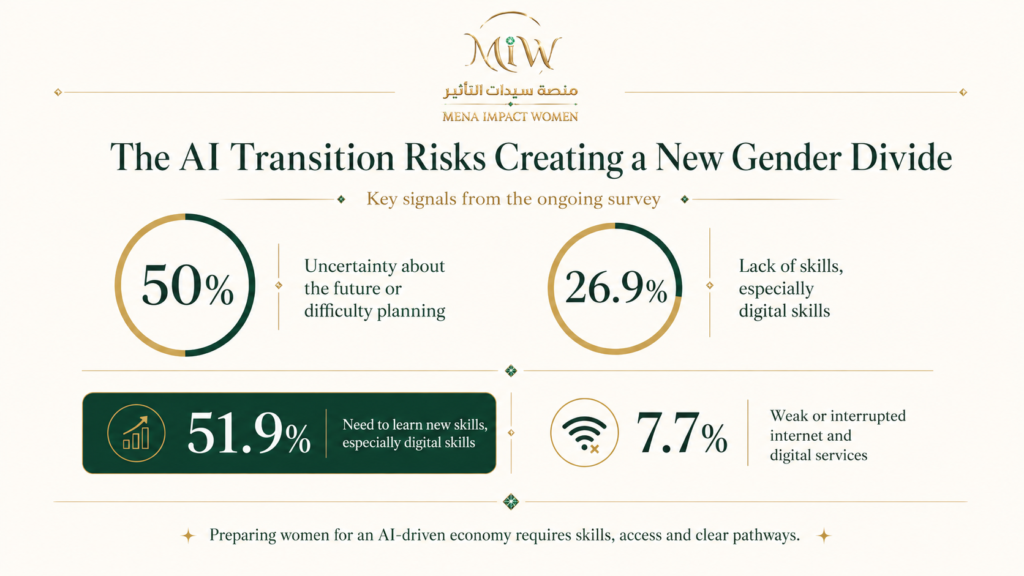
Half of respondents—50%—identified uncertainty about the future or difficulty planning as a major current challenge. 26.9% reported a lack of skills, particularly digital skills, while 7.7% identified weak or interrupted internet and digital services.
When asked what they most needed to improve their employment or income prospects, 51.9% selected learning new skills, especially digital skills. Access to internet or technology was also identified by 9.6%.
These findings matter because qualifications alone may no longer be enough in a labour market transformed by AI. Women need opportunities to update their capabilities, understand how their sectors are changing and use new tools within clear professional pathways.
Digital training delivered in isolation will not resolve the wider problem. The survey shows that skills needs coexist with unstable income, unsuitable opportunities, mobility barriers and uncertainty about the future. Preparing women for an AI-driven economy therefore requires a combination of relevant learning, technological access, strategic orientation and concrete routes into employment or income generation.
Without this broader support, the digital transition could reproduce the same gap already visible in the data: women may continue acquiring knowledge without being able to convert it into stable work, economic security or professional advancement.
Fresh Evidence for a Rapidly Changing Region
The findings reveal a connected chain of pressure. Rising living costs weaken economic security. Limited suitable opportunities prevent education and experience from becoming stable professional pathways. Rapid digital change increases the need for new skills while making future planning more difficult.
The survey also shows what women are prioritising now: suitable work (63.5%), improved income or financial stability (61.5%) and new skills, particularly digital skills (51.9%).
The MENA Impact Women Under Pressure Survey remains ongoing. As further responses are collected across the region, it will continue to provide updated evidence on how economic, professional, social and technological changes are affecting women’s lives and opportunities.
At a time when conditions are changing rapidly, fresh regional data are essential. They make it possible to move beyond general assumptions and identify, with greater precision, the pressures women are experiencing and the responses they consider most urgent.
Methodological note: These are preliminary findings from an ongoing Arabic-language survey conducted in 2026 among respondents residing in Egypt, Algeria, Tunisia, Qatar, the United Arab Emirates and Saudi Arabia. Multiple-response questions may total more than 100%. The findings describe the current survey group and should not be interpreted as statistically representative of all women across the MENA region.

Jusooruha ’Magazine – MENA Impact Women. All rights reserved
مجلة جسورها – منصة سيدات التأثير لمنطقة شمال أفريقيا والشرق الأوسط. جميع الحقوق محفوظة
© Jusooruha – MENA Impact Women. All rights reserved.
Pingback: كيف تصنع منصة مينا لسيدات التأثير نموذجًا جديدًا للتمكين والبحث والتعاون في المنطقة؟ - menaimpactwomen.org
Pingback: كيف تصنع منصة مينا لسيدات التأثير نموذجًا جديدًا للتمكين والبحث والتعاون في المنطقة؟ – jusooruha.menaimpactwomen.org