In a world where news, images and videos can reach us within seconds, artificial intelligence has made it increasingly easy to create content that looks convincing even when it is false or manipulated.
But technology is only part of the challenge.
We are no longer simply consumers of information. Every day, we share posts, forward messages, send videos to family members and friends, and sometimes help information travel far beyond its original source.
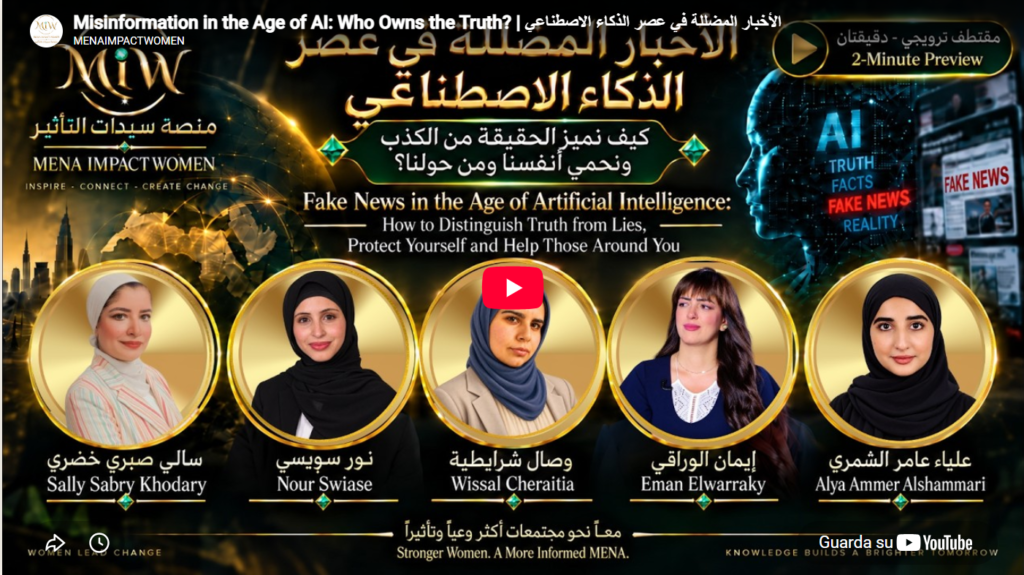
That is why MENA Impact Women organised the webinar:
“Fake News in the Age of Artificial Intelligence: How to Distinguish Truth from Lies, Protect Yourself and Help Those Around You.”
The discussion brought together women with different professional and regional perspectives to explore one central question:
How can women and girls become better equipped to recognise misleading information, protect themselves, and help the people around them do the same?
Sally Sabry Khodhary: Pause Before You Share
Sally Sabry Khodhary highlighted a simple but important reality: today, we do not merely receive information — we also participate in spreading it.
A false claim can reach hundreds or thousands of people within seconds. For that reason, she connected critical thinking and information verification with our everyday digital responsibility.
Her central question was straightforward:
Before believing information — and before sharing it — have we stopped for a moment to ask whether it is actually true?
She explained that the purpose of the webinar was to understand how misinformation can affect everyday decisions and how we can engage more consciously with what we see and hear — and, most importantly, how we can protect ourselves and help those around us do the same.
Later in the discussion, she returned to a familiar situation: seeing a shocking, frightening or anger-inducing story and immediately wanting to share it.
That moment, the speakers stressed, is exactly when we need to stop and verify.
Eman Elwarraky: Giving Women Tools to Protect Themselves
Investigative journalist and artificial intelligence trainer Eman Elwarraky approached the issue from a highly practical perspective.
Her intervention focused on a question that goes directly to the heart of the webinar:
What can a woman do to avoid becoming a victim?
She explained that misinformation does not only concern political or public news. It can affect women’s personal lives, finances, children and families.
She illustrated this through a personal experience involving a medical clinic. After requesting information about a product supposedly used during her treatment, she received an image from the clinic. By checking the image digitally, she discovered that it had been taken from a completely different context.
From this experience, she introduced the idea of “healthy scepticism.”
It does not mean distrusting everything.
It means asking questions when something does not add up:
Where did this information come from?
Is the source reliable?
Does the story make sense?
Can I verify it?
She then described three broad stages: think critically, verify the source, and use technical verification tools when necessary.
She also discussed reverse-image searches and video-verification tools, stressing that these skills no longer belong only to journalists and investigators. Ordinary users can learn them too.
Wissal Cheraitia: Children Need Skills, Not Only Protection
Wissal Cheraitia took the discussion into another essential area: children and digital literacy.
She presented Umaiz, an educational initiative designed to help children understand and navigate the digital and media environment with greater confidence.
She explained that many approaches to children’s internet use focus mainly on restriction, fear and protection.
Umaiz takes a different approach: building skills and confidence.
The initiative works not only with children but also with parents, schools and teachers, creating a wider support network around them.
One of its main activities is “The Little Investigator,” an interactive workshop for children aged 8 to 14 in which media literacy and fact-checking are taught through games and discovery.
The aim is not to explain every piece of information to children.
It is to give them the tools to eventually evaluate information for themselves.
Nour Swiase: How Do We Verify What We See?
Drawing on her experience with Womanly, Nour Swiase explained how a platform that publishes news approaches verification before sharing information.
She outlined a series of questions that can also be applied to our individual use of social media:
Where did the information come from?
Is the source reliable?
Have other independent sources confirmed it?
Is there evidence?
Could the image have been generated by artificial intelligence?
What is the context?
She also discussed the potential impact of convincing AI-generated images and misinformation on individuals, public trust and even the economy.
Her presentation also explored propaganda, algorithms and the narratives that reach us.
These questions formed one component of the webinar — within the broader practical challenge of learning how to decide what to trust and what to share.
Alya Ammer Alshammari: When AI Manipulation Becomes a Direct Threat to Women
Alya Alshammari presented examples of content that may appear authentic at first sight but can in fact be generated or manipulated using artificial intelligence.
She noted how much harder it has become to distinguish between authentic and artificial images, videos and online claims, making individual verification increasingly important.
She then addressed a particularly serious dimension for women: the malicious creation and distribution of fake or deepfake images of women and girls.
A key point emerged from her intervention: when a woman is targeted by manipulated content, the problem cannot simply be described as a lack of awareness on her part.
She may be the victim of someone deliberately misusing technology against her.
This led to an important exchange during the discussion:
How can women protect themselves from deepfakes and AI-generated abuse when they did not create the problem in the first place?
Eman responded that teaching women verification tools is not about making them responsible for the abuse. It is about giving them additional means to defend themselves, identify manipulation and challenge false material when it is used against them.
Before You Share: Pause, Think, Verify
One of the clearest practical messages to emerge from the discussion was also one of the simplest:
Do not let emotion make the decision for you.
Misinformation is often designed to provoke fear, anger, shock or urgency.
And those emotions can make us share first and verify later.
The discussion therefore highlighted a simple sequence:
- Pause. Do not immediately share what you have seen.
- Think. Does it make sense? Is the content deliberately trying to provoke a strong emotional reaction?
- Check the source. Who originally published it?
- Compare sources. Are credible independent or official sources reporting the same thing?
- Verify the content. When necessary, use tools to investigate images, videos or suspicious AI-generated material.
Digital Protection Begins with Knowledge
The message of the webinar was not that women should fear artificial intelligence.
Nor was it that every piece of information online should automatically be treated as false.
The message was about agency.
A woman who knows how to question a source, verify an image or recognise manipulation has one more tool to protect herself.
And she can use the same knowledge to help her children, family, friends and wider community.
That is the central idea behind the webinar:
Learning how to distinguish truth from lies so that we can protect ourselves — and help those around us.
Watch Highlights from the Webinar
In this video, we share a glimpse of some of the key contributions, ideas, and discussions that emerged during the webinar.
The Full Webinar Is Coming Soon
This video is only a small preview of the full discussion.
The complete webinar recording will be published in the coming days, including the full interventions, practical examples, discussion, and questions raised by the participants.
Subscribe to the MENA Impact Women newsletter to receive the full webinar link as soon as it is published and be among the first to watch the complete recording.
Stay Connected
Subscribe to the MENA Impact Women newsletter and receive updates on our programmes, research, opportunities, events, and stories from across the MENA region.