Fresh regional data and a new strategic empowerment model reveal what is still missing between women’s capabilities and their contribution to development
“How Can Girls and Women Become Stronger Agents of Development Across the MENA Region?” This was the question that kept returning to the founders of MENA Impact Women: a group of accomplished professionals, visionary leaders and multidisciplinary experts with deep knowledge of the region and experience across international development, gender studies, human rights, international cooperation, communication for development, institutional relations, engineering and innovation, business administration, economics and international trade.
It was not an abstract question. It emerged from years of professional experience and from a shared concern that, despite decades of programmes, reforms and investment, too many women were still unable to transform their knowledge, qualifications and experience into stable opportunities, economic participation and meaningful influence.
The question became even more urgent as the region entered a period of intensifying economic, political, social and technological pressure. Rising living costs, fragile labour markets, conflict, displacement, mobility restrictions and rapid digital transformation were creating new risks precisely when women’s capabilities, leadership and participation were becoming increasingly important to the region’s resilience and future development.
The founders reached the same conclusion: the region did not need another initiative built on assumptions about what women lacked. It needed fresh evidence about women’s current realities and a practical model capable of turning existing capabilities into direction, agency and action.
This conviction led to the launch of the ongoing Arabic-language MENA Impact Women Under Pressure Survey and the development of a new research series designed to investigate unresolved problems, identify the conditions that continue to prevent progress and test responses that can strengthen women’s contribution to the economic, scientific, social and institutional development of the MENA region.
A Research Series Built on Fresh Regional Evidence
MENA Women Under Pressure is the new women’s empowerment research series of MENA Impact Women. It examines the evolving economic, professional, social, institutional and technological pressures affecting girls and women across the Middle East and North Africa.
Its starting point is the ongoing MENA Impact Women Under Pressure Survey, an Arabic-language regional survey created to collect fresh evidence directly from women’s reported experiences, priorities and needs. The survey explores professional and economic conditions, income stability, decision-making capacity, perceived opportunities, digital access, exposure to crises and the forms of support women consider most urgent.
The survey remains open, allowing new responses to continue informing the platform’s research agenda. This means the series is not designed as a single static publication. Each report will investigate a specific dimension of the wider MENA Women Under Pressure framework, while later publications will progressively examine other interconnected pressures revealed through the evolving evidence.
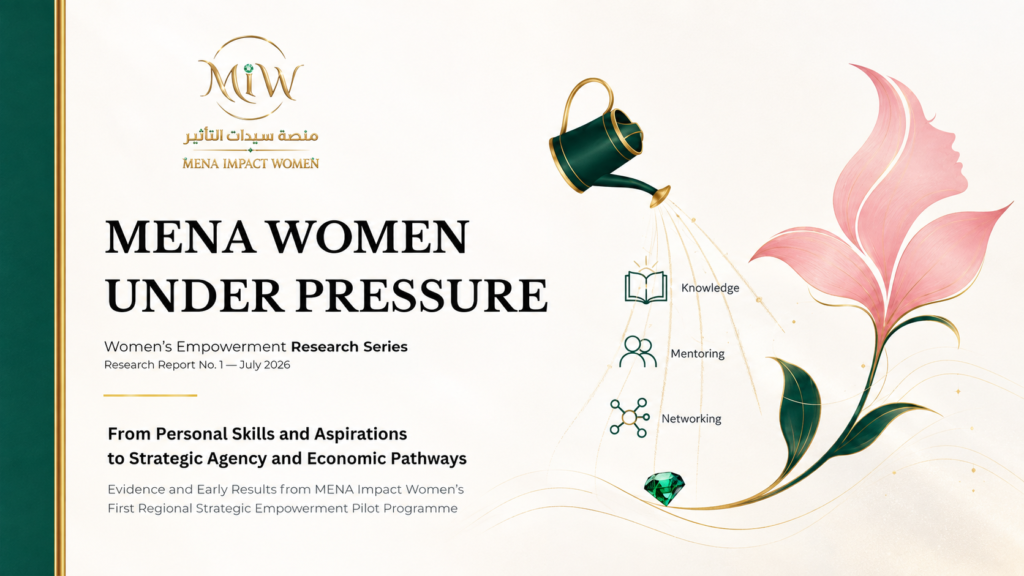
The first report focuses on one central problem: why education, skills and experience do not automatically become clear professional direction, suitable employment, stable income or meaningful participation in development.
What the First Survey Findings Reveal
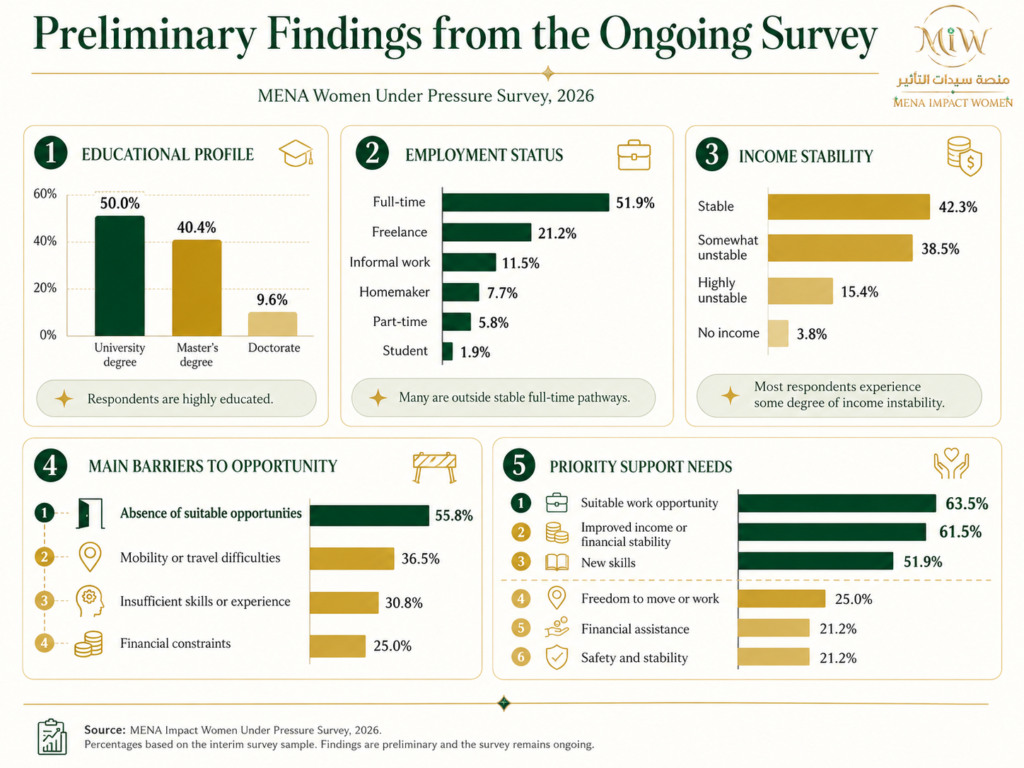
The preliminary survey findings expose a striking contradiction. Respondents are highly educated, yet many remain outside stable and suitable professional pathways.
Around half of respondents held a university degree, approximately two fifths held a master’s degree and a smaller group held doctorates. Despite this educational profile, almost half were outside full-time employment. Slightly more than half worked full-time, while others were freelancing, working informally or part-time, studying, managing households or navigating other forms of economic uncertainty.
Income security was even more fragile. Fewer than half described their income as stable, while more than half experienced some degree of instability or had no income. Financial decline over the previous year was also more common than improvement.
The main obstacle was not simply a lack of ambition or willingness to work. More than half of respondents identified the absence of suitable opportunities as a major barrier. Mobility and travel difficulties affected more than one third, while financial constraints, skills gaps, family responsibilities and social or cultural restrictions overlapped in different ways.
The wider environment intensified these pressures. Around two thirds of respondents reported rising living costs and declining income among the most important difficulties affecting their lives. About half identified uncertainty about the future or difficulty planning, while a similar proportion pointed to insufficient employment opportunities.
When asked what would most improve their professional and economic pathways, respondents prioritised suitable work and greater financial stability. More than half also identified the need for new skills, particularly digital capabilities. Others highlighted mobility, funding, safety, technology access, networks and sufficient time to develop independent projects.
The Problem Is Not Only Access to Skills
Taken together, these findings suggest that the central challenge cannot be reduced to education or training alone. Many respondents already possess qualifications, experience and professional potential. What remains incomplete is the pathway that enables them to recognise, organise, communicate and apply those resources within realistic economic and professional conditions.
The report describes this as a conversion gap: the distance between possessing capabilities and being able to turn them into agency, action, viable opportunities and measurable outcomes.
A woman may have knowledge but lack strategic direction. She may have freedom to act but insufficient information about how to make a professional decision. She may identify an opportunity but lack mobility, networks, time, financing or implementation support. She may wish to leave unsuitable work or develop an independent project but be unable to risk losing economic security.
This is why the report asks a deeper question than whether women have received training: what combination of direction, confidence, contextual understanding, mentoring, digital readiness, networks and practical support allows existing resources to become meaningful participation in development?
From Survey Evidence to an Applied Research Response
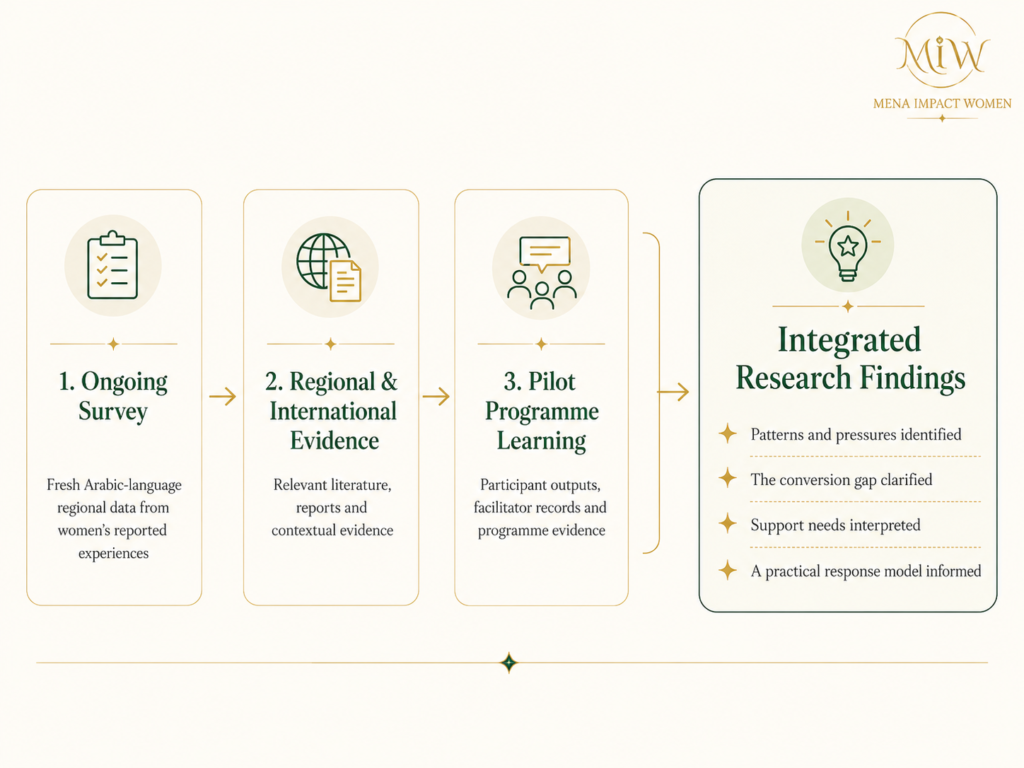
The first report does not rely on a single source of evidence. It combines the ongoing regional survey with international and regional literature and with evidence from the first pilot of the MENA Impact Women Strategic Empowerment Programme.
The research examines both sides of the same problem. The survey documents the pressures, barriers and support needs reported by women. The pilot explores how participants respond when they are supported to identify their existing resources, examine their context, define priorities and translate their capabilities into structured professional and project pathways.
This multi-source approach connects evidence with practice. It allows MENA Impact Women not only to describe the gap between skills and opportunity, but also to test a model designed to help bridge it. The report’s conceptual framework brings together three complementary perspectives: the relationship between resources, agency and achievements; the role of dialogue, reflection and action in transformative change; and the importance of women’s lived knowledge in adapting solutions to real social and economic contexts.
A New Strategic Empowerment Model
The Strategic Empowerment Programme was developed around a different starting point from conventional training. It does not assume that progress always begins by adding more information. It begins by helping participants recognise and organise what they already possess: knowledge, skills, experience, values, networks, cultural understanding and insight into the needs of their communities.
Participants then move through a structured process of skills assessment, strategic planning, service and project design, value communication, professional positioning, income development and access to markets and opportunities. Each participant translates this work into a Strategic Professional Development Plan grounded in her own circumstances and objectives.
The first pilot involved ten participants from Algeria, Egypt and Tunisia, eight of whom completed the programme. Early evidence showed progress in professional clarity, recognition of existing resources, project definition, strategic positioning and implementation planning.
The model does not suggest that individual effort can remove structural barriers. Instead, it identifies the forms of strategic and practical support that can help women act more effectively within complex realities while also generating evidence about the institutional, economic and social conditions that still need to change.
Research That Continues to Learn
This first report marks the beginning of a wider research journey for MENA Impact Women. Its framework was developed by the platform’s Lead Researcher and Facilitator, who brought together the ongoing survey, pilot evidence, participant-produced materials, facilitator records and Strategic Professional Development Plans within one connected process.
The survey first identified emerging pressures and unresolved needs. These findings then informed the design of the Strategic Empowerment Programme, while the pilot made it possible to test the model in practice and document how participants moved from uncertainty towards clearer professional direction and action.
The evidence generated through that experience now returns to the research process, helping refine the model and shape the questions that will guide the next stage. Because the survey remains open, new responses will continue to deepen the platform’s understanding of women’s changing realities across the region.
Future reports in the MENA Women Under Pressure series will build on this growing evidence to explore further economic, technological, social, political and institutional pressures—creating a research process that continuously moves from evidence to action, and from action to new knowledge.
From Women’s Potential to Regional Development
The first research report offers an evidence-based starting point for understanding how women’s existing capabilities can contribute more fully to the future of the MENA region.
Its findings shift the focus from what women are presumed to lack to the value they already hold: knowledge, qualifications, professional experience, creativity and insight into their communities. The next challenge is to connect these resources with the opportunities, institutions and support required to turn them into lasting contribution.
At a moment of acute regional pressure, women’s participation is not only an equality objective. It is essential to stronger economies, more resilient institutions, greater innovation and a better collective future for the MENA region.

Jusooruha ’Magazine – MENA Impact Women. All rights reserved
مجلة جسورها – منصة سيدات التأثير لمنطقة شمال أفريقيا والشرق الأوسط. جميع الحقوق محفوظة
Pingback: Women Under Pressure: Three Emergencies Reshaping Women’s Lives Across MENA - menaimpactwomen.org
Pingback: كيف تصنع منصة مينا لسيدات التأثير نموذجًا جديدًا للتمكين والبحث والتعاون في المنطقة؟ - menaimpactwomen.org
Pingback: كيف تصنع منصة مينا لسيدات التأثير نموذجًا جديدًا للتمكين والبحث والتعاون في المنطقة؟ – jusooruha.menaimpactwomen.org