Girls & Women from Algeria, Egypt and Tunisia unite to turn shared challenges into impact
MENA Impact Women has begun its journey with the successful completion of its first pilot programme, bringing together girls and women from Algeria, Egypt and Tunisia to turn existing knowledge, experience and capabilities into clearer professional direction and practical social impact.
The pilot marked the first practical test of a new regional approach to strategic empowerment. Developed by an independent, women-led platform shaped by professional expertise and lived experience across MENA and international contexts, it connected research, learning, professional development and action.
Participants were supported in recognising the value of what they already knew, identifying the challenges they were best positioned to address and translating their capabilities into projects, services and professional pathways. In doing so, the programme began to confront a persistent gap: the distance between women’s potential and the opportunities, structures and visibility needed to convert it into sustainable outcomes.
“Research and innovation create meaningful change when knowledge becomes accessible and people are able to use it to shape their own futures,” said Carmen Panepinto Zayati, Co-Founder and Research and Innovation Advisor of MENA Impact Women.
“This pilot reflects our commitment to bringing knowledge closer to action and helping girls and women recognise their capabilities, develop new solutions and contribute to scientific, technological and social progress,” continued Panepinto Zayati, a visionary young engineer bridging Italian and Tunisian cultures, currently pursuing doctoral research in the United States in biorobotics and regenerative medicine, with a focus on limb regeneration and STEM empowerment.

A New Platform for Girls’ and Women’s Strategic Empowerment
Across the region, education, experience and talent do not always lead to economic independence, leadership or visible social impact. Girls and women may already possess valuable knowledge, skills and deep insight into their communities, yet still face barriers in turning those resources into clear opportunities and realistic paths forward.
MENA Impact Women was established to address this conversion gap. The platform connects applied research, strategic empowerment, publishing, professional visibility and regional collaboration, helping girls and women move from capabilities to direction and from direction to sustainable impact.
Its approach begins by recognising not only what girls and women may need, but also what they already bring: knowledge, networks, lived experience and community insight. The pilot translated this principle into practice and laid the foundation for a regional model shaped by their realities, ambitions and contributions.
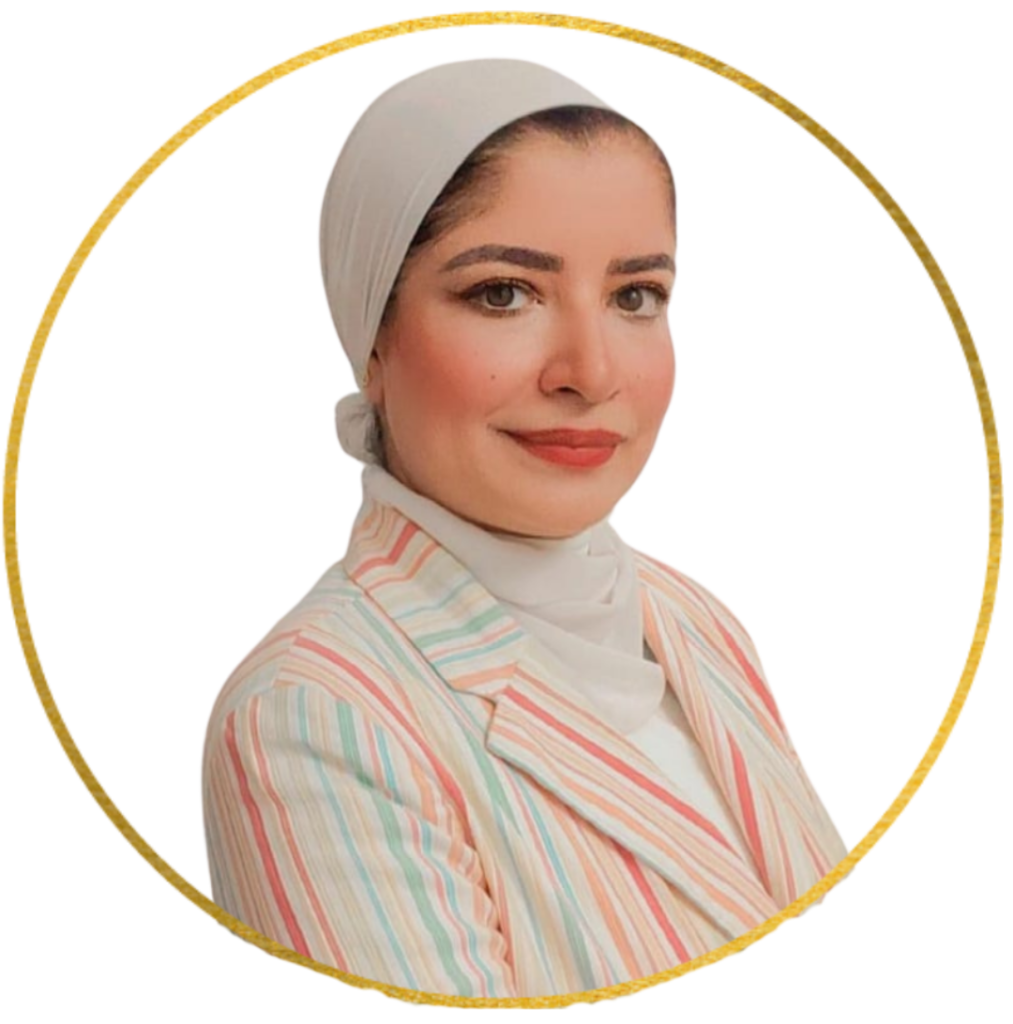
“Girls and women across the region are already creating knowledge, building communities and leading change, but their work is too often fragmented or insufficiently visible,” said Sally Sabry Khodary, Vice President and Egypt Lead of MENA Impact Women.
“Our role is to strengthen the connections between girls, women, institutions and opportunities, using communication, education and regional collaboration to turn individual potential into collective and sustainable impact,” continued Khodary, a leading Egyptian voice in media, communication and regional development.
Turning Existing Capabilities into Strategic Direction
The Strategic Empowerment Programme was designed around a simple but often overlooked principle: progress does not always begin with acquiring more skills. It may begin with recognising, organising and applying the capabilities a person already possesses.
Participants explored skills assessment, strategic planning, service design, value communication, professional positioning, income development and access to markets and opportunities. Each woman then translated this learning into a Strategic Professional Development Plan grounded in her own experience, responsibilities and objectives.
The programme’s concept, research foundation and learning methodology were developed within MENA Impact Women by the Lead Facilitator and Researcher, who guided participants throughout the pilot and documented the evidence and practical lessons emerging from the process. Presenting this responsibility as an institutional role recognises the intellectual and methodological contribution while preserving the platform’s current authorship and privacy arrangements.
Women from Three Countries Join the First Pilot Programme
The first cohort brought together girls and women from Algeria, Egypt and Tunisia with different educational backgrounds, professional experiences and ambitions. Although they followed a shared learning journey, each participant developed a direction shaped by her own capabilities, values and objectives.
The programme did not lead everyone towards the same outcome. Participants transformed early ideas into structured initiatives, repositioned professional experience and began moving scientific research towards practical application.
For Rym Ben Ameur, a senior graphic designer from Tunisia, the programme became an opportunity to develop Artizenie, an initiative connecting contemporary design with Tunisian craftsmanship and creating stronger income opportunities for craftswomen.
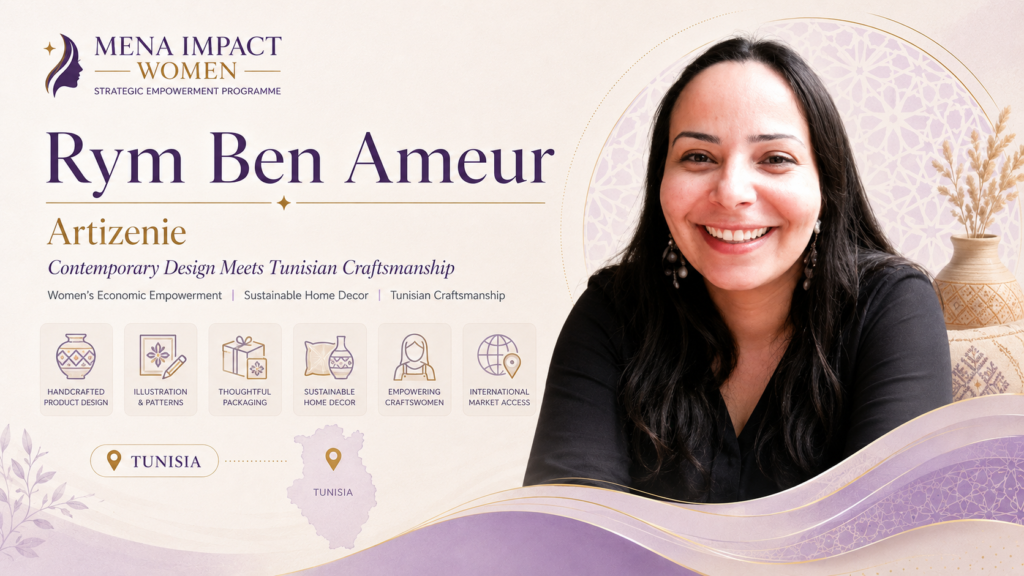
“Over the past two months, I developed a comprehensive project proposal that reflects both my skills and my core philosophy: designing and creating handcrafted products that protect the environment, empower craftswomen towards financial independence and improve their living conditions,” she said.
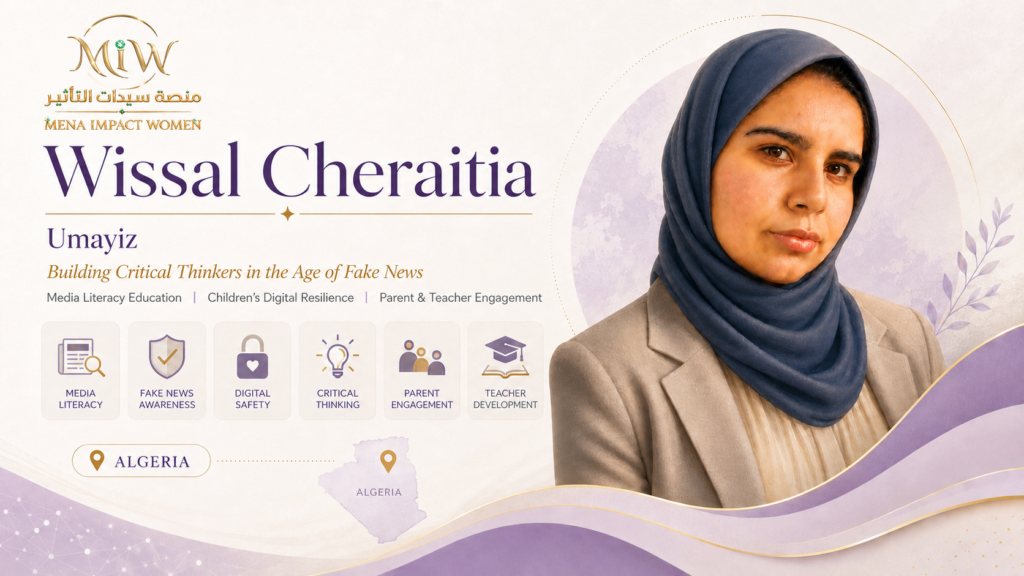
From Algeria, media literacy professional Wissal Cheraitia used the programme to develop Umayiz, an educational platform helping children recognise misinformation and navigate the digital world more safely.
“This experience helped me clarify my ideas, see my abilities from a different perspective and gain a new methodology for strategic thinking. It gave me the confidence to transform an idea into a complete project with clear objectives and a practical plan,” Cheraitia explained.
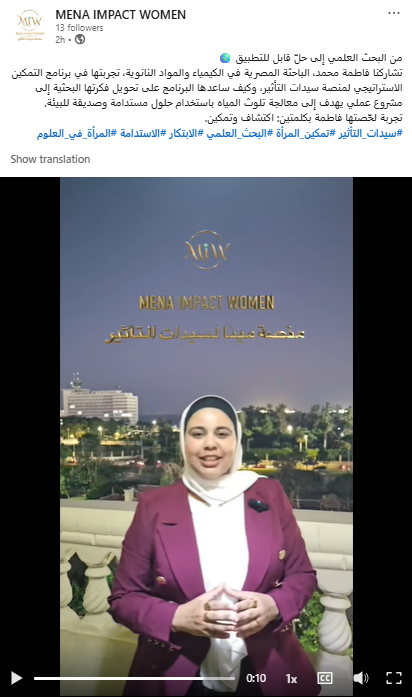
For Egyptian chemistry and nanomaterials researcher Fatma Mohamed Mahmoud, the journey focused on moving scientific knowledge closer to real-world application. Her initiative explores reusable and environmentally responsible nanomaterial solutions for water remediation and industrial wastewater treatment.
For Egyptian chemistry and nanomaterials researcher Fatma Mohamed Mahmoud, the journey focused on moving scientific knowledge closer to real-world application. Her initiative explores reusable and environmentally responsible nanomaterial solutions for water remediation and industrial wastewater treatment.
“Through the programme, I learned how to build a strategic plan and a business model, and how to transform a scientific research idea into a product that can be applied and brought to market. In two words, my experience was discovery and empowerment,” Mahmoud said.
Together, these experiences show the diversity of paths that can emerge from a shared strategic framework. MENA Impact Women’s graduate profiles present participants not only through qualifications and job titles, but through the challenges they understand, the value they can create and the impact they are working to achieve. They are also designed to support future connections with institutions, partners, professional networks and communities.
The First Pilot Produces Projects and Professional Transitions
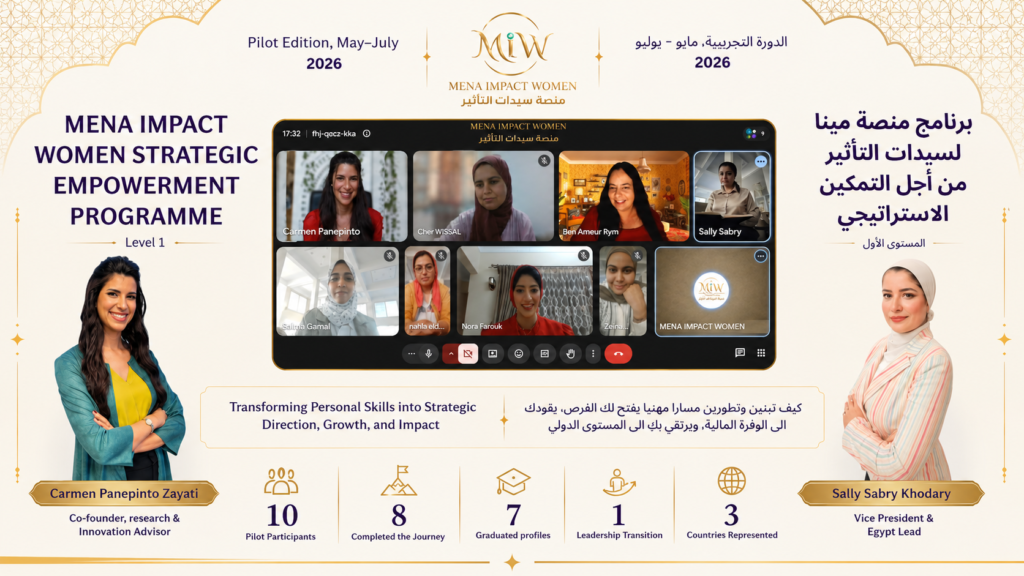
The first pilot transformed the platform’s emerging model into a practical learning experience. Ten women enrolled from Algeria, Egypt and Tunisia, and eight completed the learning journey. Seven developed final projects and Strategic Professional Development Plans, while one moved into a formal leadership role within MENA Impact Women after supporting the Egyptian participant group.
The outcomes extended across creative industries, media literacy, environmental science, education, community development and women’s economic participation. More importantly, the pilot generated evidence about the different forms of support required when women move from skills and aspirations towards implementation.
The experience showed that training alone is rarely enough. Strategic direction also depends on contextual analysis, mentoring, professional positioning, networks, digital readiness, suitable opportunities and continued implementation support. These lessons will inform the next stage of the programme and the platform’s wider research agenda.
From a First Pilot to a Regional Model
The completion of the first pilot is a beginning rather than an endpoint. It has established an initial community, tested the programme’s methodology and created a bridge between the platform’s research and its practical work.
MENA Impact Women will continue examining how girls and women can convert education, knowledge and experience into viable professional, economic and social pathways. By treating participants as contributors to knowledge rather than passive beneficiaries, the platform aims to build approaches that are regionally grounded, internationally connected and capable of evolving through evidence.
The first step has now been taken: from shared challenges to strategic direction, and from strategic direction towards a new era of women-led impact.

Jusooruha ’Magazine – MENA Impact Women. All rights reserved
مجلة جسورها – منصة سيدات التأثير لمنطقة شمال أفريقيا والشرق الأوسط. جميع الحقوق محفوظة
Pingback: Women Under Pressure: Three Emergencies Reshaping Women’s Lives Across MENA - menaimpactwomen.org
Pingback: كيف تصنع منصة مينا لسيدات التأثير نموذجًا جديدًا للتمكين والبحث والتعاون في المنطقة؟ - menaimpactwomen.org
Pingback: كيف تصنع منصة مينا لسيدات التأثير نموذجًا جديدًا للتمكين والبحث والتعاون في المنطقة؟ – jusooruha.menaimpactwomen.org