Tunisian Women Artisans Safeguarding and Renewing a Cultural Heritage Across Generations
Traditional crafts in Tunisia form a space where cultural memory, productive work, and renewed creativity intersect. Tunisian women artisans play a central role in transmitting the knowledge and skills associated with weaving, embroidery, pottery, and plant-fibre crafts, while adapting them to contemporary needs and markets. Their contribution is not limited to preserving material objects; it also encompasses techniques, symbols, decorative vocabularies, and social relationships that give each craft its meaning within the community.
Weaving: A Renewed Technical and Aesthetic Memory
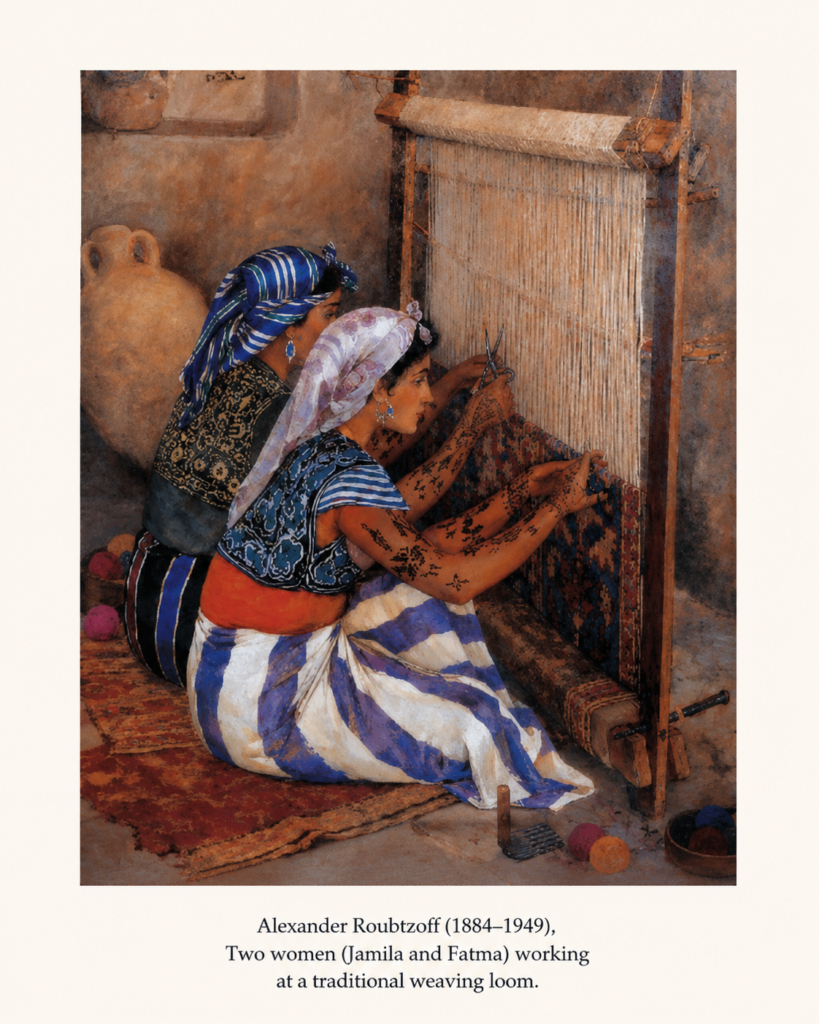
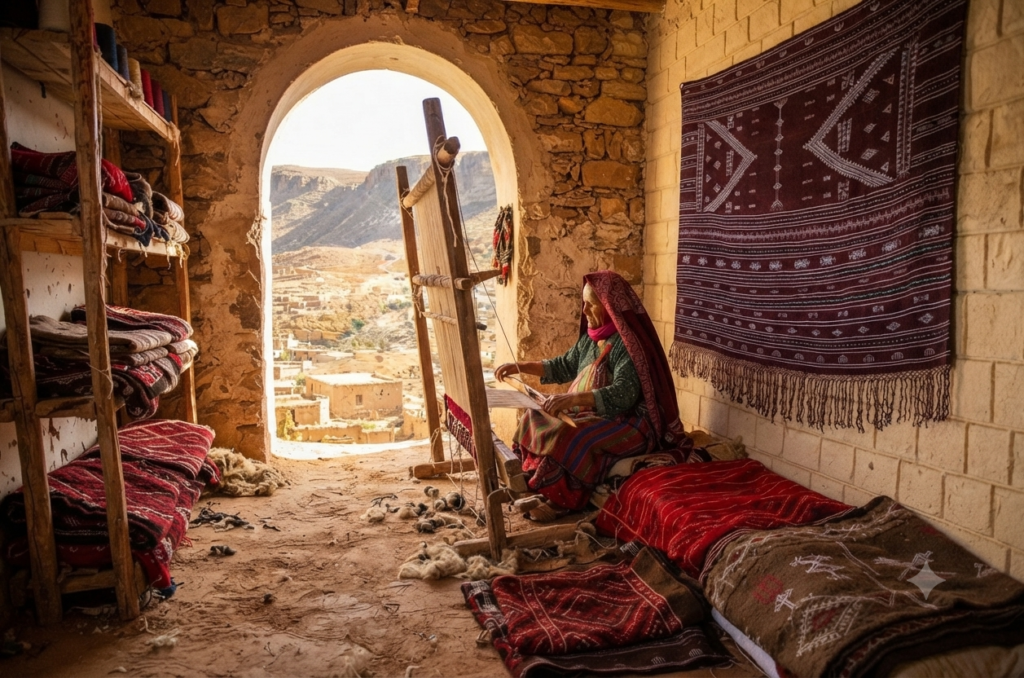
Weaving is among Tunisia’s oldest and most diverse craft traditions. Historically, it has been associated with the production of blankets, clothing, furnishings, and carpets, while its techniques and forms have developed in response to regional practices, locally available materials, and social customs. In many rural and urban settings, women have remained the principal custodians of practical knowledge related to preparing wool, setting up the loom, combining colours, and producing geometric motifs.
Following independence, the Tunisian state strengthened the institutional framework of the handicrafts sector through the National Office of Tunisian Handicrafts, established in 1959, together with vocational training and technical support structures. These institutions contributed to training, quality improvement, and product promotion. Nevertheless, the continuity of craft knowledge has continued to depend largely on women artisans themselves and on the transmission of expertise within families and local communities. [1]
Margoum: Patterns Woven from Memory and Imagination
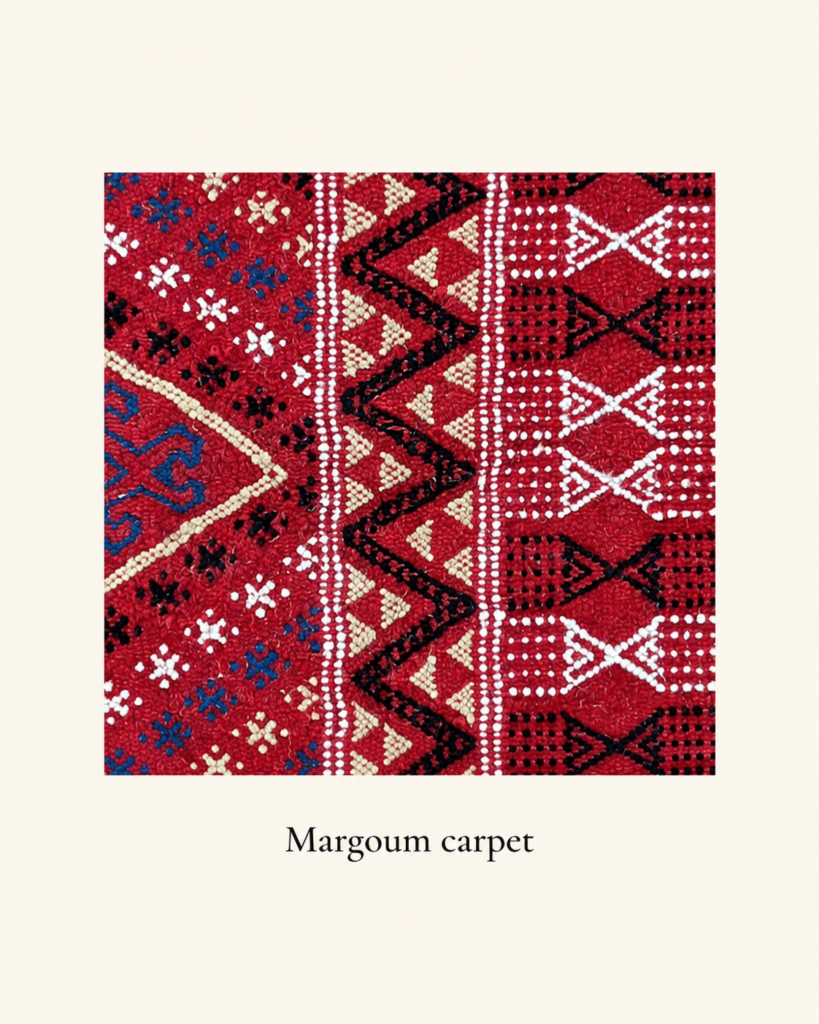
Margoum is one of Tunisia’s best-known forms of flat-woven textile. It is distinguished by geometric patterns, often based on the diamond shape and related symbolic forms. Its production is not limited to reproducing a fixed model. The artisan draws on her experience to distribute motifs, regulate visual rhythm, and harmonise colours. Margoum therefore combines precise manual work with aesthetic judgement, while each region develops its own distinctive approaches to design and use. [2]
Safeguarding margoum does not mean reproducing inherited models without change. It requires documenting techniques, ensuring their transmission to younger generations, encouraging collaboration between artisans and designers, and developing products that respect the identity of the craft while responding to contemporary uses.
Embroidery: Local Identity Carried by Clothing
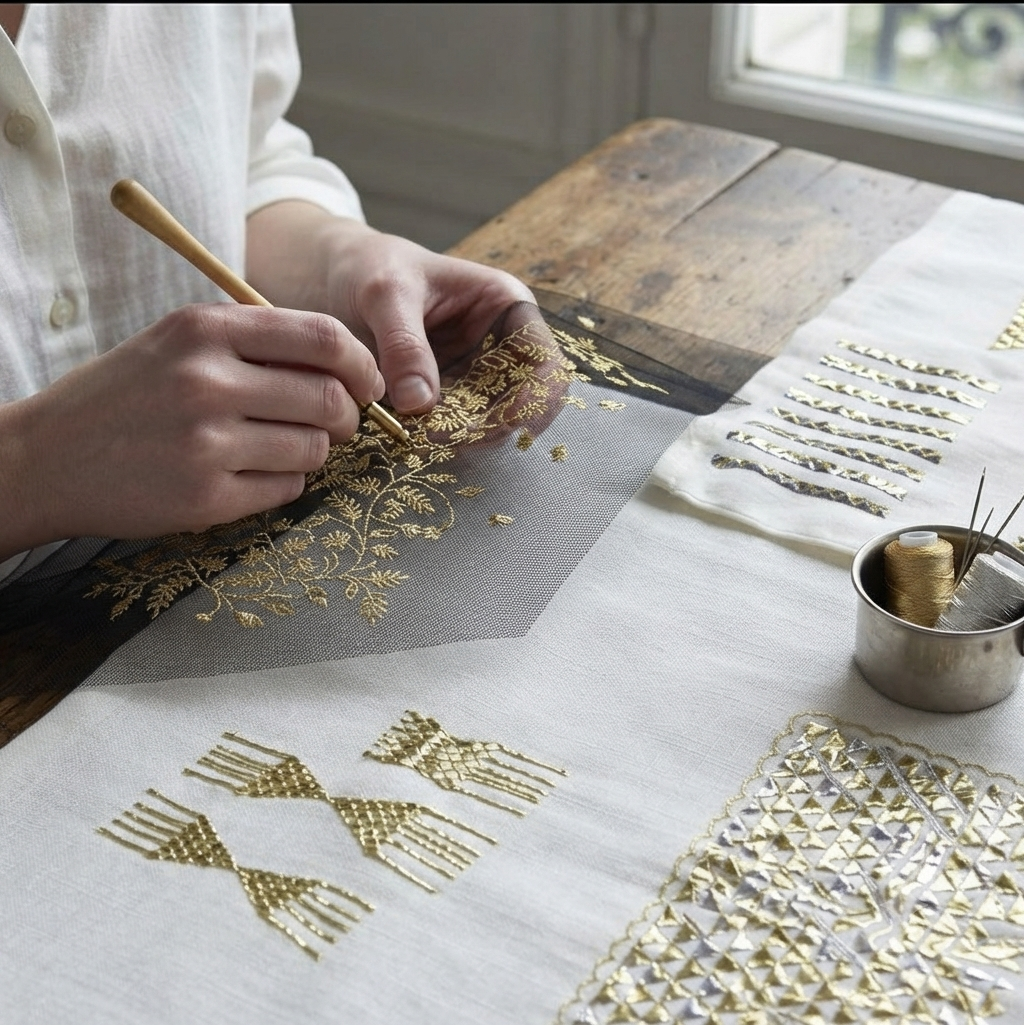
Embroidery shares with weaving a rich regional diversity of symbols, materials, and techniques. It flourished in several Tunisian cities and regions and became particularly associated with ceremonial and bridal clothing, as well as with the decoration of household textiles. Girls often learned its basic techniques at an early age from their mothers and female relatives, making the transmission of skill part of socialisation and of the construction of women’s memory within the family.
Differences in stitches, colours, and compositions reveal distinctive local identities. Embroidery can therefore be read as a visual record of geographical belonging, social position, aesthetic preferences, and broader social change. Its sustainability, however, requires protecting the knowledge embodied in the craft from being reduced to commercially decorative motifs and ensuring that designs are properly attributed to the communities and women who have preserved them.
Sejnane Pottery: A Living Heritage Led by Women
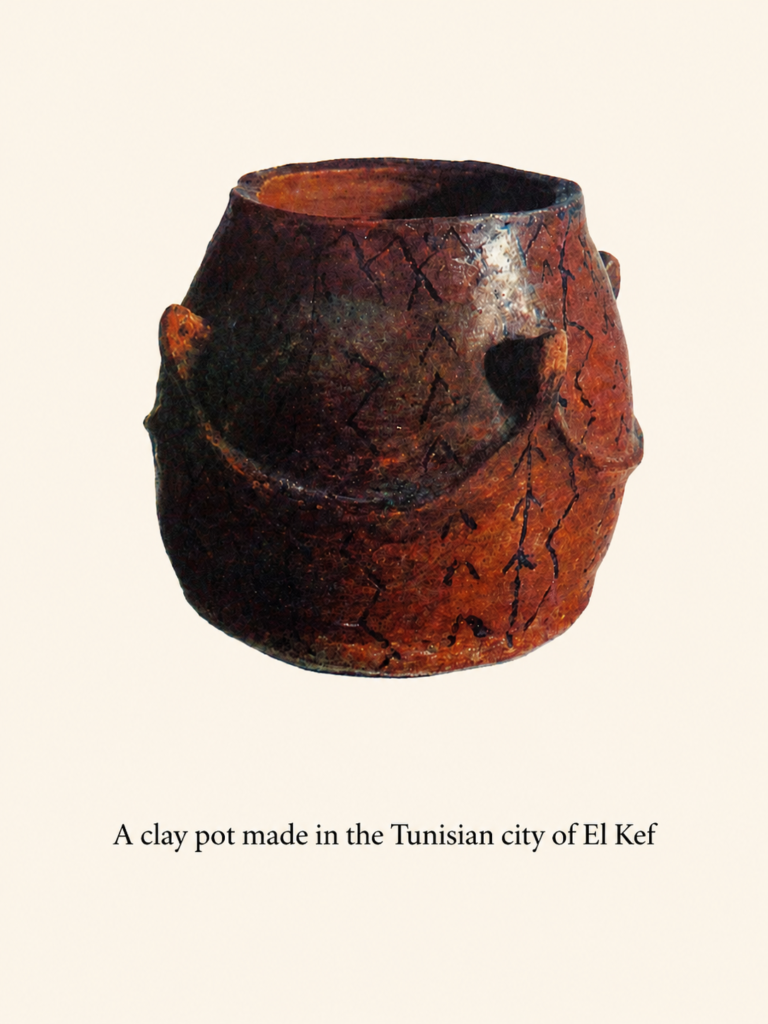
The pottery of the women of Sejnane, in northern Tunisia, is one of the clearest examples of a living heritage safeguarded and developed by women. The process begins with collecting and preparing clay, followed by hand-shaping pieces using the coiling technique, drying, firing, and decorating them with natural materials and pigments. Products include household vessels, dolls, and animal figures inspired by the local environment.
In 2018, UNESCO inscribed the pottery skills of the women of Sejnane on the Representative List of the Intangible Cultural Heritage of Humanity. The nomination file emphasises that women carry out all stages of production and also participate in selling the products, giving the craft an important social and economic dimension alongside its cultural value. [3]
The experience of Sejnane demonstrates that safeguarding heritage cannot be separated from improving artisans’ working conditions, developing fair marketing channels, and protecting the technical and symbolic authenticity of products from imitation and exploitative commercialisation.
Alfa Grass and Plant Materials: From Everyday Necessity to Contemporary Design
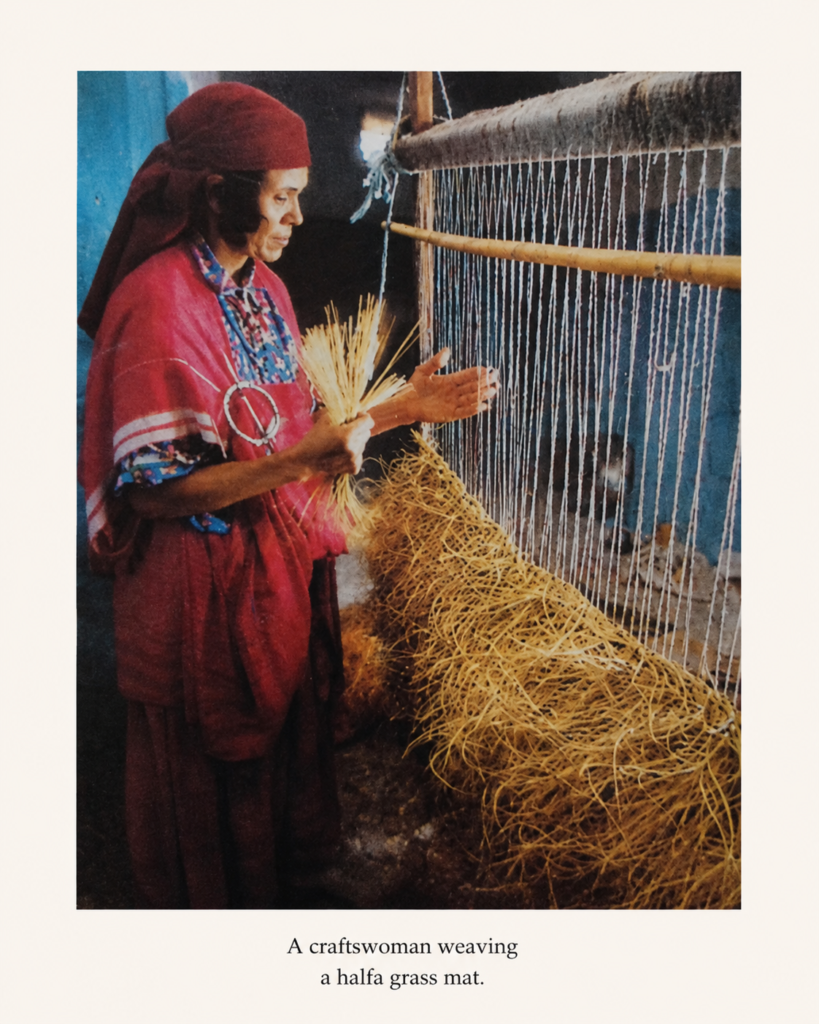
Plant-based crafts in Tunisia have traditionally relied on local materials such as alfa grass, rushes, and palm fibres. These materials have been used to produce mats, baskets, shopping bags, storage containers, and everyday household objects. Alfa grass grows particularly in central and west-central Tunisia, while oasis regions provide other fibres suitable for weaving and plaiting. Historical sources show that these plants represented an important economic resource for many families and local communities. [4]
Women artisans have developed these products by improving finishing techniques, diversifying shapes, and introducing new functions suited to contemporary homes and markets. In Kairouan, Kasserine, coastal regions, and southern Tunisia, mats and baskets appear in multiple forms, while the Gabès region is known for crafts based on alfa grass, rushes, and palm fibres. Such innovation allows these crafts to remain useful rather than becoming objects produced solely for display.
Women Artisans Between Heritage Safeguarding and Economic Empowerment
The role of women artisans is not limited to producing beautiful objects or preserving old techniques. Their work sustains collective memory, stimulates local economies, generates household income, and creates employment in areas where alternatives may be limited. Creative-industry development programmes indicate that strengthening handicraft value chains can create decent and sustainable employment, especially for women, when training and design support are combined with access to markets and finance. [5]
Economic empowerment, however, does not arise automatically from practising a craft. It requires fair remuneration, recognition of artisans’ ownership of their knowledge and designs, improved working conditions, easier formal registration and access to social protection, and stronger digital marketing and business-management skills. It also requires policies that prevent cultural heritage from being transformed into a commercial resource detached from the communities that have preserved it.
Tunisian women artisans safeguard a heritage that does not survive in museums alone, but in the movement of the hand, in accumulated knowledge, and in the relationship between local materials, memory, and innovation. From weaving and embroidery to Sejnane pottery and plant-fibre crafts, these traditions demonstrate women’s capacity to combine continuity with renewal. Protecting this heritage therefore begins with recognising its women custodians, documenting their knowledge, and ensuring that they benefit fairly from the cultural and economic value they create.
References
1. Centre for Research, Studies, Documentation and Information on Women (CREDIF). (n.d.). Femme, culture et créativité en Tunisie [Women, Culture and Creativity in Tunisia]. Tunis: CREDIF. Available through the CREDIF catalogue.
2. Tunisian National Tourist Office. (n.d.). Artisanat des régions tunisiennes [Handicrafts of the Tunisian Regions]. Discover Tunisia. Accessed 6 August 2026.
3. United Nations Educational, Scientific and Cultural Organization (UNESCO). (2018). Pottery skills of the women of Sejnane. Representative List of the Intangible Cultural Heritage of Humanity, File No. 01406.
4. Encyclopédie berbère. (2012). “Alfa.” OpenEdition Journals. Discusses alfa grass and its traditional uses in the Maghreb, including women’s craft production in Tunisia.
5. United Nations Industrial Development Organization (UNIDO). (2023). Creative Industries: Supporting Handicrafts and Design Value Chains. Vienna: UNIDO.
6. UNESCO. (2018). Decision of the Intergovernmental Committee 13.COM 10.B.38: Inscription of the pottery skills of the women of Sejnane on the Representative List of the Intangible Cultural Heritage of Humanity.
7. La Presse de Tunisie. (2 April 2026). “Poterie de Sejnane: un héritage ancestral féminin à préserver.” Supplementary journalistic source; it does not replace UNESCO’s official nomination file.

Jusooruha ’Magazine – MENA Impact Women. All rights reserved
مجلة جسورها – منصة سيدات التأثير لمنطقة شمال أفريقيا والشرق الأوسط. جميع الحقوق محفوظة
Rym Ben Ameur is a graduate of the MENA Impact Women Strategic Empowerment Programme and a member of its regional network of women professionals. Explore Rym’s project.